Builder Home > Ask an Expert


Search typar.com:
 

find_dealer

Ask an Expert

Need more details about a specific product, application or installation? Read through our list of questions by actual users to see if your question has been answered.

General
Energy Savings
Installation
Competitive
Warranty

General

Q. What types of cladding can TYPAR® building wraps and accessories be used behind?
A. All types. From stucco and brick to vinyl and cedar lap siding, TYPAR is the ideal weather resistant barrier.

Q. My lumber sales rep told me that James Hardie requires the use of asphalt felt. Is this true? Can I not use TYPAR with HardiePlank™?
A. TYPAR® HouseWrap™, which is approved by ICC, is appropriate for installation beneath HardiePlank siding and similar products.

Q. Is “regular” TYPAR housewrap approved for commercial use? I was under the impression that it was, but now I see you have MetroWrap™. What is that?
A. Of course you can use TYPAR HouseWrap for light commercial applications, but TYPAR MetroWrap is designed to stand up to the rigors of commercial construction. Unlike other building wraps, MetroWrap withstands greater wind loads at six floors and above — where many commercial buildings are vulnerable. MetroWrap also provides up to 12 months of UV resistance — a huge benefit in terms of frequently changing construction schedules.

Q. Our church maintenance committee is redoing the exterior of our 50-year-old building. The building has no interior vapor barrier. The exterior is currently cedar siding, but we plan on replacing it with vinyl siding. Questions: What kind of wrap would be suitable for the exterior (are there different types of wrap for different siding applications)? And, in the absence of an interior vapor barrier, does TYPAR have sufficient breathability, while at the same time acting as a proper moisture barrier for walls?
A. Great questions! TYPAR MetroWrap is the best choice for your project. It is a commercial grade that offers the same performance benefits as TYPAR HouseWrap with additional enhanced features, such as greater wind and UV resistance. It is suitable for all types of cladding and offers exceptional water holdout and moisture vapor transmission. Check out the PDFs in our Library for more information.

Q. Do you recommend your housewrap for older house renovations?
A. Definitely. The TYPAR® Weather Protection System is an excellent way to protect the integrity of older homes and preserve your renovation investment for years to come. Superior air and water holdout, exceptional moisture vapor transmission and ultraviolet stability are just a few of the benefits of TYPAR. In addition, you’ll realize greater energy efficiency.

Q. Can TYPAR HouseWrap be used as an interior vapor barrier?
A. No. TYPAR cannot be used as an interior vapor barrier as it is designed to allow moisture to pass through it in the form of gasses. In general, vapor barriers are only allowed to have very low or no breathing capability.

Q. Is TYPAR fire rated? If so, what are the flame spread and smoke #’s?
A. TYPAR HouseWrap is fire rated with a smoke spread index of 0 and a flame spread index of 30.

Q. I’m installing a clay tile roof over plywood decking in a hurricane-prone area. How can I keep the plywood protected during construction, as well as during the life of the roof?

Back to the top

Energy savings

Q. Will wrapping my home save energy? I am in a house that is not wrapped and my heating bills are too high.
A. If you are planning to re-side your home, you should definitely consider the TYPAR Weather Protection System. At the heart of the system is TYPAR HouseWrap which acts as an air and moisture barrier, while simultaneously allowing moisture vapor to escape from the wall cavity to the outside. Installed before the exterior siding, TYPAR HouseWrap protects your home from Nature’s harshest elements and has exceptional tear strength and ultraviolet stability. It also provides energy-efficiency for years to come, which is important for energy- and budget-conscious consumers. According to DOE and ENERGY STAR®, continuous air barriers such as TYPAR HouseWrap could reduce your energy cost as much as 15% to 20%.

Q. What is the R-value of TYPAR?
A. TYPAR does not have an R-value in and of itself. It does, however, contribute to total number of the R-value of the insulation used.

Back to the top

Installation

Q. Can I use just any construction tape with TYPAR HouseWrap?
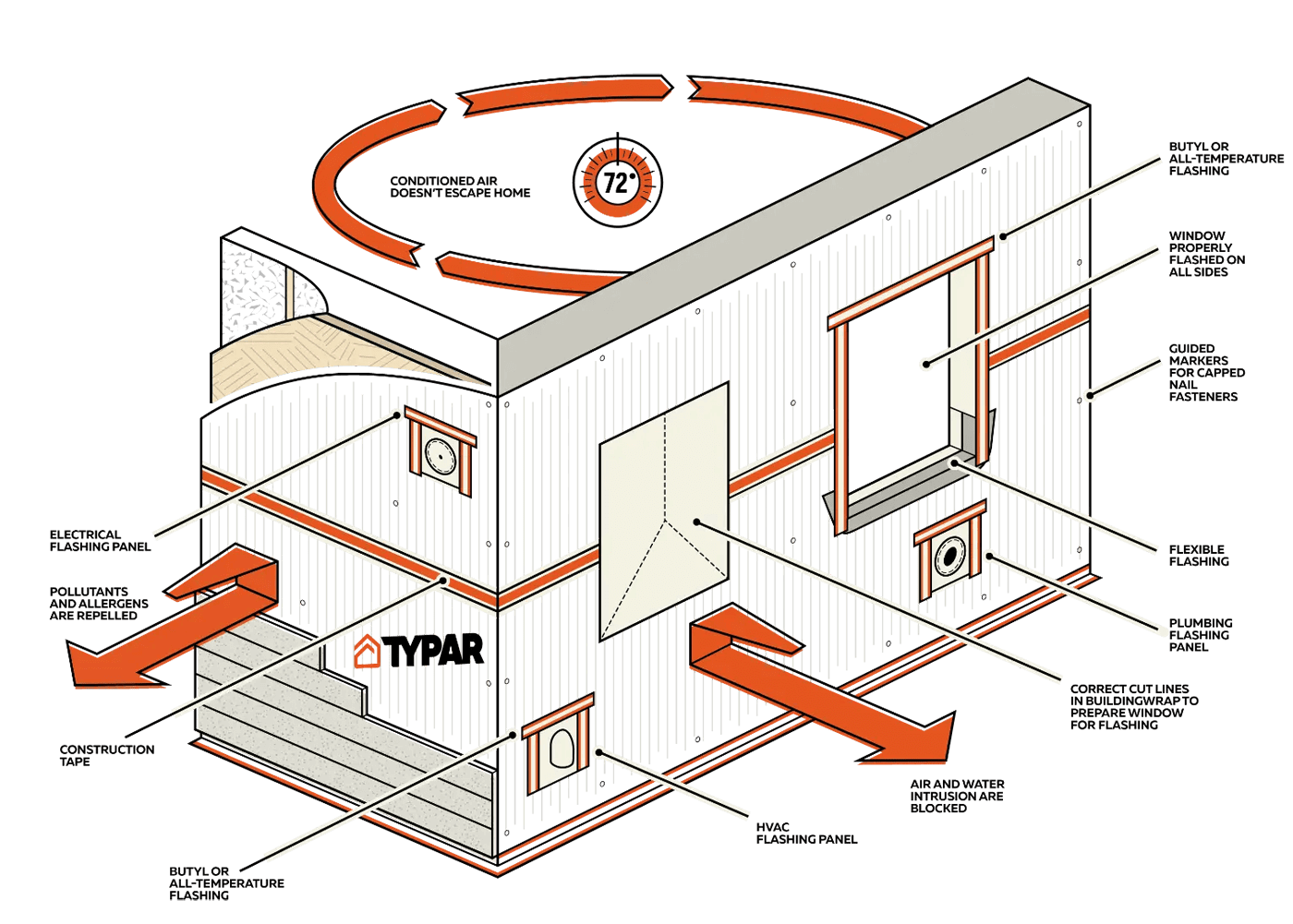
A. TYPAR® Construction Tape is the only tape that we could recommend to ensure that the TYPAR Weather Protection System is properly installed. You’re also protected by our system warranty when you use TYPAR tape and flashings.

Q. Can TYPAR® building wraps be applied over felt paper?
A. Because felt does not have adequate breathability and can actually trap moisture in the wall cavity, we would not recommend installing TYPAR over felt. TYPAR® HouseWrap is designed to allow moisture to escape the wall cavity.

Q. What is the recommended distance between nails when installing TYPAR building wraps?
A. When attaching TYPAR on wood-base sheathing, such as 7/16” OSB or 15/32” plywood, apply plastic-capped staples or plastic-capped nails every 32 inches (vertically and horizontally). When attaching TYPAR on an open stud or non-structure sheathing, apply plastic-capped staples or plastic-capped nails long enough to penetrate the stud every 32 inches (vertically and horizontally). When installing TYPAR over steel frame, use screws with washers.

Q. What is the best installation method for TYPAR building wraps, flashings and tape?
A. For complete installation instructions, visit our Library. There you’ll find complete, downloadable PDF instructions for the entire system of products.

Q. I need to know if TYPAR has a Florida Product Approval number. If so, what is it please?
A. Florida does not require an approval for housewrap products as it is part of the building code. However, Miami-Dade County has its own code requirement for impact resistant products. TYPAR® StormWrap™ meets the Miami-Dade County Code requirements for impact resistance.

Q. I am renovating the exterior of my home and installing foam board insulation, but I am receiving conflicting advice on how to wrap the house. Do I place TYPAR on before or after the foam board? I’m finishing with vinyl siding.
A. Foam board has been used as a replacement for OSB and plywood. Housewrap in general, and TYPAR in particular, should be installed over the board as a final layer prior to the installation of cladding. TYPAR HouseWrap will perform as the secondary water barrier.

Q. A builder client of ours has installed TYPAR backwards at a rim joist location. Should this be of concern?
A. TYPAR HouseWrap has a special UV coating on the light side that protects it from sunrays. If it is possible to replace it with the correct (the light) side out you will be assured that the product performance is at its maximum. Also, incorrect installation may void your warranty.

Q. Does TYPAR HouseWrap have an ICBO number? An inspector has asked my installer for one, but we can’t seem to locate it.
A. TYPAR does not use ICBO numbers anymore. The ICC has combined all the old numbers under one new system. The new ICC number for HouseWrap is ICC ESR-1404. You should eliminate your old ICBO numbers and begin using the new ICC numbers.

Q. I’d like to give away TYPAR as incentives to local homebuilders. How can I have TYPAR printed with my company name and logo on it?
A. This is a great way for builders and dealers to promote their brands in association with the TYPAR line — especially in areas with strict signage regulations. There is a minimum order requirement, and TYPAR retains the right to review and approve the proposed logo and message. Your local TYPAR dealer can provide all the details and assist you in ordering product.

Back to the top

Competitive

Q. I was recently told your product is made by DuPont™ — the same people who make Tyvek®. Is this true? And what are the key differences between TYPAR and Tyvek?
A. This is probably the most-asked question that we receive. No, TYPAR is not made by DuPont. It is manufactured by Fiberweb™, Inc., Old Hickory, TN. To see the TYPAR Advantage, please check out the TYPAR vs. Tyvek comparison chart.

Q. Our builder told us that installing Tyvek® under cedar shingles may not be a good idea, but that we could install TYPAR® in that application. Is this true?
A. Yes. Because TYPAR® HouseWrap has distinct advantages over any other housewrap product, TYPAR succeeds in many applications where other products may fall short, including under shingles. Please see the TYPAR vs. Tyvek comparison chart.

Back to the top

Warranty

Q. I have been working on my home for several years, and the TYPAR I originally installed over the sheathing has been exposed up to two years in some areas. Now I’m ready to install the siding. Should I install new TYPAR first? If so, do I have to remove the old TYPAR, or can I just put the new over it?
A. TYPAR HouseWrap needs to be covered within 6 months in order for your warranty to remain valid (within 12 months for TYPAR® StormWrap™ and MetroWrap™). It is also the recommended maximum exposure time to protect against UV exposure. With this in mind, you should remove the old TYPAR and reinstall new TYPAR prior to the installation of shingles.


Print this page

©2009 Fiberweb - Dealer/Distributor Login - Contact Us
Typar® and all Typar products denoted with ® or TM are registered trademarks or trademarks of Fiberweb, Inc.